McDowell Institute Promotes the Exchange of Competing Ideas at the University of Richmond
National news is rife with reports of America’s decline in civility and increasing polarization. But at the University of Richmond, the Gary L. McDowell Institute offers a possible solution for mending the fraying social fabric. Named for a former professor of leadership studies, the institute honors the memory of Gary McDowell through its commitment to the civil exchange of diverse viewpoints on issues in governance, economics, and law.
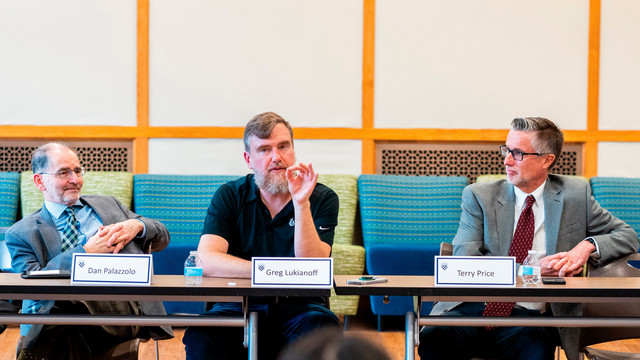
So it is fitting that Greg Lukianoff, president and CEO of the Foundation for Individual Rights and Expression (FIRE), served as the institute’s inaugural practitioner-in-residence in 2025. On Nov. 18, he met with students and gave a public presentation on free speech in higher education.
“Today we have greater awareness of free speech on college campuses — but a lot less free speech,” Lukianoff said, attributing this paradox to a lack of diverse opinions among faculty. “We need to kick the tires, have more structured friction, more political diversity in higher education. We could benefit from implementing listening projects, where the goal is not to change someone’s mind, but to listen and understand the perspective of someone who holds a different view.”
This is exactly what the McDowell Institute does.
Founded in 2020, the institute grew out of and subsumed the Jepson School of Leadership Studies’ John Marshall International Center for the Study of Statesmanship, the brainchild of McDowell. Dan Palazzolo, professor of political science, and Terry Price, Coston Family Chair in Leadership and Ethics and professor of leadership studies and philosophy, politics, economics, and law (PPEL), served at different times alongside McDowell as co-directors of the Marshall Center.
After McDowell retired, Palazzolo and Price successfully advocated for the name change to honor their friend and colleague. Housed in the Jepson School, the McDowell Institute retained the Marshall Center’s commitment to cross-school collaboration, but its programming focus shifted.
“The Marshall Center was primarily outward facing,” Price said. “Dan and I wanted to redirect programming to internal audiences, especially our students.”
To that end, the institute launched a student fellows program in 2020–21 with an inaugural cohort of 20 fellows. Today, the program is 59 fellows strong.
“The structure of the institute — co-directors, student fellows, and faculty discussion leaders drawn from different schools — exemplifies one of the core values of the institute: to welcome all members of the University community and a wide range of political perspectives,” Palazzolo said. Faculty members Kevin Cherry (political science), Erik Craft (economics and PPEL), Jessica Flanigan (leadership studies and PPEL), and Lidia Radi (French and Italian studies) serve as discussion leaders.
“Student fellows read works from ideological perspectives that are typically underrepresented in the classroom,” Price said. “Our fellows are diverse in their own politics but clearly appreciate exposure to the ideas of people with whom they disagree. They are not always convinced, but they learn how to read and listen carefully and disagree constructively — something a Richmond graduate should be able to do.”
This year, the fellows are reading The New York Times opinion columnist Ross Douthat’s book Believe: Why Everyone Should Be Religious. He will give a public lecture on the same topic on March 26.
“We want students, faculty, and staff to have the opportunity to hear some of the nation’s most interesting, thoughtful writers speak to important enduring and contemporary issues,” Palazzolo said.
Heidi Thompson, program coordinator for the McDowell Institute and the Jepson School, seconded Palazzolo on this point. “McDowell Institute lectures are special opportunities to be in the room, for free, with thought leaders and newsmakers, people we might otherwise only read online, hear on podcasts, or see on TV,” she said. “Every program I’ve attended has had something — a detail, a story, a question posed by someone in the audience — that has made me consider an issue from a different perspective, thereby broadening my thinking.”